The History of Live Music in Grand Rapids: From Jazz Clubs to Modern Arenas
Grand Rapids, Michigan has long been more than a furniture manufacturing hub or a mid-sized Midwest city. Beneath its practical reputation runs a deep current of musical energy — one that stretches back more than a century and has shaped the cultural identity of West Michigan in ways that still resonate today. From smoky jazz rooms on Division Avenue to sold-out nights at Van Andel Arena, the city's live music story is one of genuine community, artistic ambition, and remarkable staying power.
Grand Rapids' Early Soundscape — The Jazz and Blues Era
Grand Rapids developed a recognizable live music culture in the early 20th century, rooted in jazz and blues traditions that migrated north with the Great Migration. By the 1920s and 1930s, the city's African American neighborhoods — particularly along Division Avenue and the near south side — had cultivated a cluster of clubs and ballrooms where local and traveling musicians performed regularly.
These weren't just entertainment spots. They were social institutions. At a time when segregation shaped daily life, jazz clubs in Grand Rapids offered Black residents spaces of genuine freedom and expression. Performers who toured the broader Midwest circuit often stopped in Grand Rapids, drawn by engaged audiences and a growing local scene that could hold its own against larger cities.
The blues influence ran parallel. Working-class neighborhoods embraced the raw emotional directness of blues music, and informal performance spaces — bars, social halls, church basements — kept that tradition alive even when it wasn't visible to mainstream city life. This grassroots foundation would prove essential to everything that followed.
Mid-Century Venues and the Rise of Live Entertainment
Through the 1940s and 1950s, Grand Rapids saw the emergence of more dedicated live music venues that served as genuine community gathering points. Ballrooms and supper clubs became central to the city's social calendar, hosting big band performances and early rock and roll acts as musical tastes shifted after World War II.
This era also marked the beginning of a more professionalized local music economy. Venue owners invested in sound systems, stage infrastructure, and booking relationships with regional promoters. For the first time, attending live music in Grand Rapids felt like a real event — something you dressed for, planned around, and talked about afterward.
Performing arts spaces also expanded during this period. The city's investment in civic cultural infrastructure — concert halls, community auditoriums — reflected a broader national trend of mid-century American cities positioning themselves as culturally serious places. Grand Rapids was no exception, and these investments created performance spaces that would serve the community for decades.
Rock, Funk, and the 1970s–1980s Club Scene
The 1970s and 1980s transformed Grand Rapids' live music landscape as rock, funk, and eventually punk and new wave reshaped what audiences wanted from a night out. A new generation of smaller clubs and bars emerged to meet that demand, particularly in and around downtown and the areas that would later become the entertainment district.
These decades were defined by intimacy. A 200-capacity club where a local band played originals on Friday and a regional touring act came through on Saturday became the essential format. The West Michigan music scene developed its own internal ecosystem — local bands building followings, venues competing for talent, and a community of regulars who treated the scene as a second home.
The funk influence deserves particular mention. Grand Rapids had a vibrant funk and soul tradition that often went underdocumented but was deeply felt in the clubs and on the streets. This music — danceable, communal, rooted in African American musical tradition — kept venues packed and built some of the city's most loyal music audiences.
Local original music also gained real traction during this period. Rather than simply importing acts from Detroit or Chicago, Grand Rapids began producing its own artists who could draw crowds on their own name. That shift — from consumer city to producer city — was a turning point in Michigan music history.
The 1990s Boom — Indie, Alternative, and Bigger Stages
The indie and alternative music wave of the 1990s gave Grand Rapids' live scene its most significant expansion to that point. National acts touring behind the alternative rock explosion found Grand Rapids a reliable stop on the Midwest circuit, and the city's mid-sized venues were well-positioned to host them.
The grunge and alternative boom also energized local music culture in a specific way: it lowered the barrier to entry. You didn't need a polished sound or expensive equipment to start a band and play shows. That democratization produced an explosion of local acts, and venues responded by opening their stages to original music more consistently than any previous era.
Colleges played a role here too. With a significant student population drawn from across Michigan and beyond, Grand Rapids had a built-in audience hungry for live music that went beyond classic rock covers. That audience pressure pushed venues to book more adventurously and helped establish the city's reputation for supporting emerging artists.
By the late 1990s, Grand Rapids had shed any remaining reputation as a cultural backwater. The downtown entertainment district was taking shape, and the infrastructure for a genuinely diverse live music ecosystem — small clubs, mid-size theaters, outdoor spaces — was largely in place.
Modern Arenas and the Professionalization of Live Music in Grand Rapids
The opening of Van Andel Arena in 1996 marked the clearest single moment of transformation in Grand Rapids' live music history. The arena, with a capacity exceeding 10,000, immediately elevated the city's status as a major Midwest concert destination and brought national and international touring acts that previously bypassed West Michigan for Detroit or Chicago.
Van Andel Arena didn't replace the club scene — it expanded the total ecosystem. A city that could host both a 150-person indie show on a Tuesday and a 12,000-person arena concert on a Saturday had something genuinely rare: a complete live music infrastructure serving every scale of experience.
The arena's presence also had economic ripple effects across downtown Grand Rapids. Hotels, restaurants, and bars benefited from concert nights, and the entertainment district developed a density and vitality that reinforced itself. Businesses that might have been skeptical of a downtown location found that proximity to a major venue changed the calculus entirely.
This professionalization extended beyond the arena. Booking agencies, production companies, and sound engineering talent concentrated in Grand Rapids during this period, creating a local industry infrastructure that supported live music at every level.
The Downtown Entertainment District and Today's Thriving Venue Scene
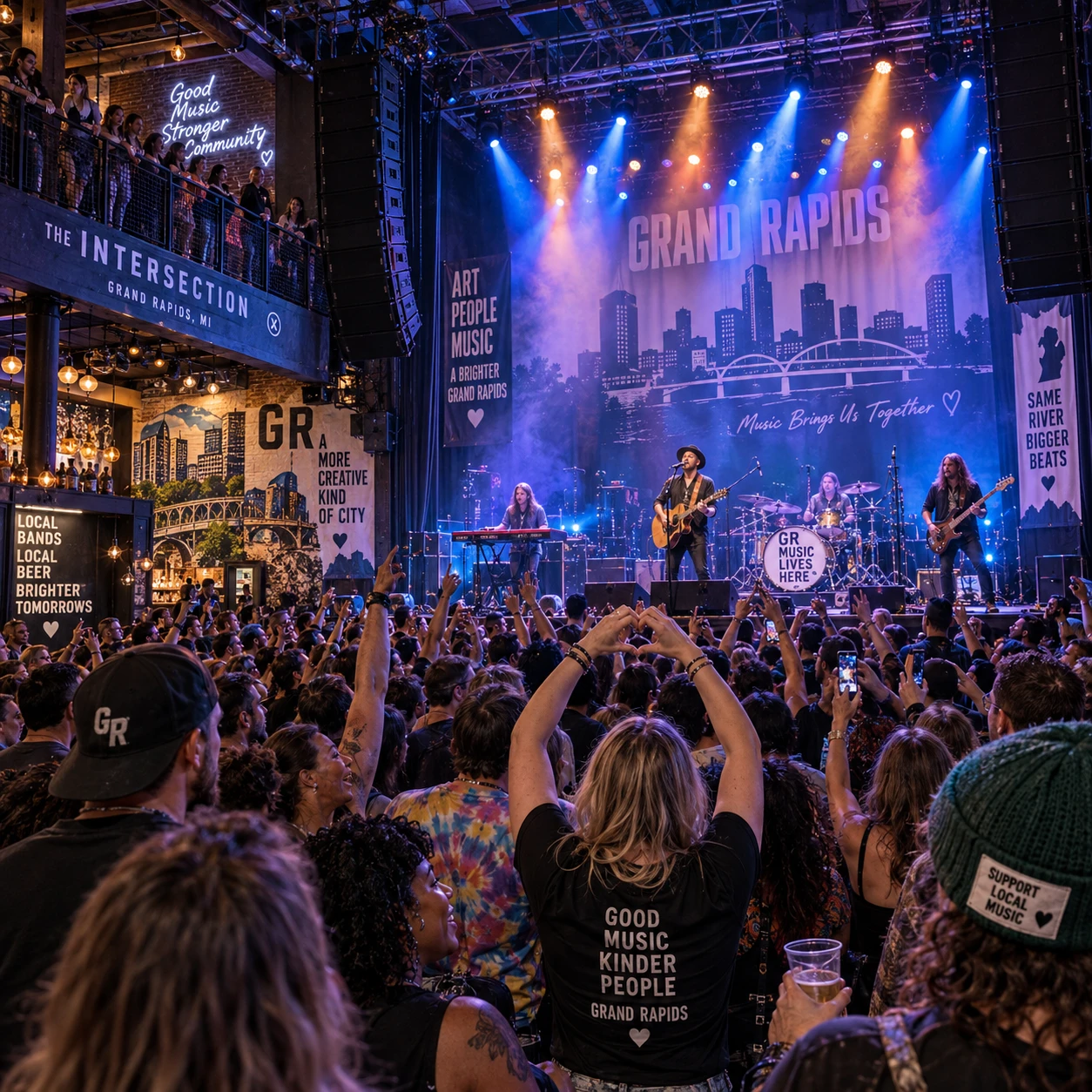
Today, Grand Rapids' live music scene is defined by its diversity of options across genres and venue sizes. The downtown entertainment district anchors the experience, but music spills out across the city — into neighborhood bars, brewery taprooms, outdoor amphitheaters, and performing arts centers.
The range is genuinely impressive. On any given weekend, a visitor to Grand Rapids might find jazz at an intimate lounge, a local rock band at a mid-size club, a national touring act at a theater, and a major arena show — all happening simultaneously. That density of options is the direct product of more than a century of accumulated venue culture and community investment in live music.
The genres have diversified too. Hip-hop, electronic music, Latin music, bluegrass, and classical all have dedicated audiences and regular programming in Grand Rapids. The city's growing demographic diversity has driven that expansion, and venues have largely responded by broadening their booking rather than retreating into safe, familiar territory.
Community engagement remains central to what makes the Grand Rapids music scene work. Local festivals, free outdoor concerts, and venue-sponsored community events keep live music accessible across income levels — a tradition that traces directly back to those early jazz clubs where music served a social function as much as an entertainment one.
Why Grand Rapids Remains a Must-Visit City for Live Music Lovers
Grand Rapids stands out as a Midwest live music destination because of the combination of scale, diversity, and genuine local character. Unlike cities where live music culture is imported wholesale or exists only at the arena level, Grand Rapids has built its scene from the ground up over more than a century.
The city's size works in its favor. Large enough to attract major touring acts and support professional venues, but compact enough that the entertainment district feels walkable and connected rather than sprawling and anonymous. A single evening can move naturally from dinner to a club show to a late-night bar with live music — all within a few blocks.
There's also something to be said for the audience itself. Grand Rapids music fans are engaged, loyal, and genuinely knowledgeable. That culture of serious listening and community support for local artists creates an atmosphere that performers notice and return for. It's not uncommon for touring musicians to single out Grand Rapids crowds as among the best on a Midwest run.
For anyone planning to experience live music in West Michigan, the history matters — not as nostalgia, but as context. Understanding that the venue you're walking into exists within a century-long tradition of community music-making changes how the experience feels. Grand Rapids didn't become a great live music city by accident. It earned that status one show at a time.
Frequently Asked Questions
What was the first major live music venue in Grand Rapids?
Pinpointing a single "first" is difficult, but the earliest significant live music spaces in Grand Rapids were ballrooms and social clubs that emerged in the early 20th century, particularly those serving the city's African American community during the jazz era. These venues predated purpose-built concert halls and were essential to establishing Grand Rapids as a city with a genuine live music culture.
How has the Grand Rapids music scene changed over the decades?
The scene has evolved from informal jazz and blues clubs in the early 1900s through mid-century ballrooms, the intimate club scene of the 1970s and 1980s, the alternative music boom of the 1990s, and into today's multi-tiered ecosystem that includes everything from neighborhood bars to Van Andel Arena. Each era added infrastructure and audience depth without fully displacing what came before.
What genres of music have historically been most popular in Grand Rapids?
Jazz and blues formed the foundation, followed by rock and funk through the mid-to-late 20th century. The 1990s brought strong alternative and indie music culture, and today the city supports a genuinely diverse range including hip-hop, country, classical, and electronic music. No single genre dominates — which is part of what makes the scene resilient.
Are there historic music venues in Grand Rapids still operating today?
Several venues in Grand Rapids have long histories, though the specific continuity varies. The entertainment district has seen venues open, close, and reopen under different names over the decades. The culture of the spaces often persists even when the names change, and some locations have hosted live music continuously for generations.
What makes Grand Rapids a notable city for live music in the Midwest?
Grand Rapids combines the infrastructure of a major market — including a large arena capable of hosting national touring acts — with the intimate club culture of a smaller city. That combination, built over more than a century, creates a live music ecosystem that serves audiences at every scale and price point. The city's engaged fan base and strong community support for local artists reinforce that reputation year after year.